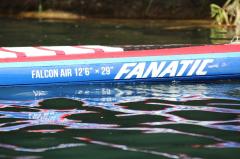
 When you think of travelling on a commercial airline with a
stand-up paddleboard (SUP), you normally think of: strange looks at the
check-in desk, expensive carbon fibre, baggage handling hassles and a few
logistical difficulties. This time it was a mysterious red bag on wheels, and I
am converted. This bag contained a 12’6” by 29” Fanatic Falcon Air inflatable
SUP, a 3 piece paddle, a pump, and most of my clothes for the trip.
When you think of travelling on a commercial airline with a
stand-up paddleboard (SUP), you normally think of: strange looks at the
check-in desk, expensive carbon fibre, baggage handling hassles and a few
logistical difficulties. This time it was a mysterious red bag on wheels, and I
am converted. This bag contained a 12’6” by 29” Fanatic Falcon Air inflatable
SUP, a 3 piece paddle, a pump, and most of my clothes for the trip.
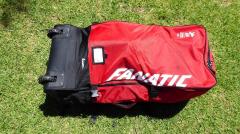
This was my first time travelling with an inflatable SUP, or
using one from start to finish of the inflation cycle for that matter. I had
previously only ever grabbed a pre-inflated one at a demo day or a race, so I
hadn’t fully appreciated their logistical benefits. It was so easy to wheel
through the airport, check in, and I could chuck it in the back of a car at the
other end and not worry about organising roof racks. I just had to ensure the
valve on the board was in the deflate position and clothes were wrapped around
the parts of the paddle/pump that could rub on each other or the board. Then it
was pretty much indestructible.
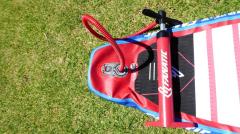 The inflation point on the Falcon Air is very well designed.
When you put the valve into the inflate position it only lets air in, which is
very reassuring knowing that you will not lose half of your hard work if the
pump is disconnected. The twist-lock between the pump and the board is easy to
use and secure, the hose will not disconnect by itself.
The inflation point on the Falcon Air is very well designed.
When you put the valve into the inflate position it only lets air in, which is
very reassuring knowing that you will not lose half of your hard work if the
pump is disconnected. The twist-lock between the pump and the board is easy to
use and secure, the hose will not disconnect by itself.
Pumping the board up, I initially had the pump in the dual action setting, so that it could inflate the board on both the up and down strokes. Although this was an efficient way of inflating the board I found the pump making a squeaking noise on the up stroke due to the small air intake. 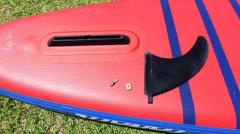 I took out the valve cap to convert the pump into a single action (only down) pump and this was much quieter, I also found it easier this way. I was told to inflate the board to between 16 and 20 PSI, which required a lot more strokes than I was used to with my bike pump, but I found it to be a good warm-up. It did take some time for the gauge to start registering a pressure, but once the pressure starts to build to a registrable level it increases pretty quickly. I inflated the board to 19 PSI, which seemed to make the board very hard and took around 10 minutes (on subsequent trips I have tried the board at 16, 17 and 18 PSI and only noticed marginal differences in performance).
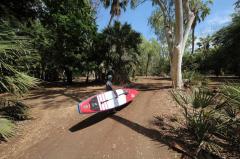 I was impressed straight away by the weight of the board
fully inflated and ready to paddle. It was very easy to carry to the water or
lift above your head to put on the roof of the car. The removable fin slotted
into the board very easily and didn’t require any tools. The bungy straps on
the front of the board were also handy for tucking my thongs under, a nice
addition.
I was impressed straight away by the weight of the board
fully inflated and ready to paddle. It was very easy to carry to the water or
lift above your head to put on the roof of the car. The removable fin slotted
into the board very easily and didn’t require any tools. The bungy straps on
the front of the board were also handy for tucking my thongs under, a nice
addition.
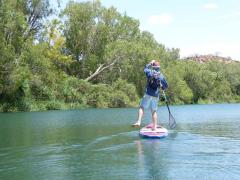 Time for the first paddle… Launching the board into the
water felt great, it was very stable and the deck pad was nice and soft on the
knees, probably aided by a little bit of give in the board’s surface. The board
felt surprisingly rigid once up and standing, probably the most so out of the
inflatables I have tried. You could get the board to flex if you were bouncing
up and down on it, but under normal paddling I didn’t notice it. Paddling on
the board was very stable and I was able to move my feet around the board
comfortably, easily transitioning to the back of the board to get the nose up
and turn it around.
Time for the first paddle… Launching the board into the
water felt great, it was very stable and the deck pad was nice and soft on the
knees, probably aided by a little bit of give in the board’s surface. The board
felt surprisingly rigid once up and standing, probably the most so out of the
inflatables I have tried. You could get the board to flex if you were bouncing
up and down on it, but under normal paddling I didn’t notice it. Paddling on
the board was very stable and I was able to move my feet around the board
comfortably, easily transitioning to the back of the board to get the nose up
and turn it around.
 The nose shape of the Falcon Air is really nice, the entry
of the board displaces water well, it doesn’t push water and it is rounded
enough so that it doesn’t want to nose steer. It actually felt quite fast,
faster than I was expecting. I think the rounded rails of the inflatable and
the 12’6” of length contributed to giving it a nice glide. This glide was a
good motivator to keep up the pace and I ended up doing a decent distance. The
stiffness of the board and the little bit of nose rocker made me think it would
be quite fun in the waves also.
The nose shape of the Falcon Air is really nice, the entry
of the board displaces water well, it doesn’t push water and it is rounded
enough so that it doesn’t want to nose steer. It actually felt quite fast,
faster than I was expecting. I think the rounded rails of the inflatable and
the 12’6” of length contributed to giving it a nice glide. This glide was a
good motivator to keep up the pace and I ended up doing a decent distance. The
stiffness of the board and the little bit of nose rocker made me think it would
be quite fun in the waves also.
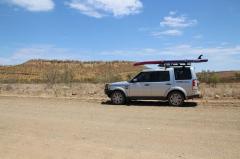 Back to shore and I was very impressed. I was going to go
for another paddle later so I released some air out of the board, reducing the
risk that the heat would cause it to over-pressurise, and strapped it to the
roof of the car. After my next few paddles I was still very satisfied with the
performance of the Fanatic Falcon Air 12’6”.
Back to shore and I was very impressed. I was going to go
for another paddle later so I released some air out of the board, reducing the
risk that the heat would cause it to over-pressurise, and strapped it to the
roof of the car. After my next few paddles I was still very satisfied with the
performance of the Fanatic Falcon Air 12’6”.
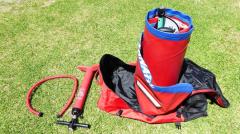 When I wanted to pack up the board, I made sure it was dry,
pushed in the valve and locked it in the release mode. This allowed all of the
air to come out of the board whilst rolling it up. Keeping the valve in the
deflate position whilst rolled up enabled the board to equalise in pressure when
flying or in the bag on the roof of the car. I was told to make sure the board
was completely dry before storing it rolled up for a long period of time. This
was because if it heats up too much the moisture can “steam” the glued parts of
the board and affect the bonds. It dries very quick in the sun.
When I wanted to pack up the board, I made sure it was dry,
pushed in the valve and locked it in the release mode. This allowed all of the
air to come out of the board whilst rolling it up. Keeping the valve in the
deflate position whilst rolled up enabled the board to equalise in pressure when
flying or in the bag on the roof of the car. I was told to make sure the board
was completely dry before storing it rolled up for a long period of time. This
was because if it heats up too much the moisture can “steam” the glued parts of
the board and affect the bonds. It dries very quick in the sun.
 Overall I think an inflatable SUP, like the Fanatic Falcon
Air is an excellent addition whilst travelling. I think it would be vital if
flying to anywhere with a decent waterway that you want to explore, you can see
so much standing up. I am impressed with the quality and ease of paddling of
the Fanatic and would recommend it to others.
Overall I think an inflatable SUP, like the Fanatic Falcon
Air is an excellent addition whilst travelling. I think it would be vital if
flying to anywhere with a decent waterway that you want to explore, you can see
so much standing up. I am impressed with the quality and ease of paddling of
the Fanatic and would recommend it to others.